-
Archive
-
Exhibition
Anna Kournikova Deleted By Memeright Trusted System – Art in the Age of Intellectual Property
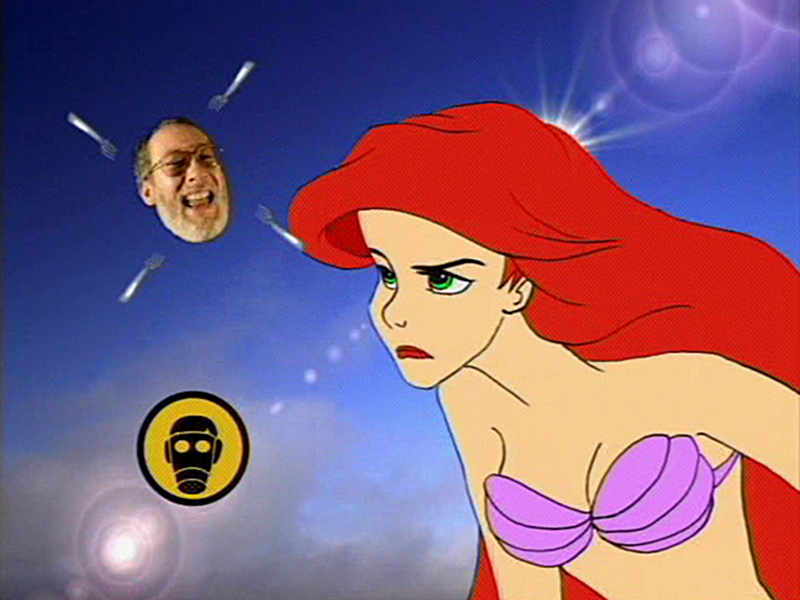
‘You can’t use it without my permission ... I’m gonna sue your ass!’ shouts Disney’s Little Mermaid with the angry voice of a copyright lawyer in the video Gimme the Mermaid (4:49 min., 2000).
The video by Negativland and Tim Maloney, situated at the exhibition entrance, is one of twenty eight works included in Anna Kournikova Deleted By Memeright Trusted System - Art in the Age of Intellectual Property, an exhibition presented by Hartware MedienKunstVerein (HMKV). It is part of the project "Work 2.0 – Copyright and Creative Work in the Digital Age". In the framework of "Work 2.0", HMKV – together with the Berlin-based collaborative partner iRights.info/mikro e.V. – explores the relationships between creative work, intellectual property law, and technology.
About the exhibition
How does the changing notion of (creative) work relate to ‘intellectual property’? Today we live in a post-industrial society where the goods being produced are no longer material (like steel, coal, etc.), but immaterial. The Ruhr Area, with its vast deindustrialised landscape, paradigmatically stands for this transition from the Industrial Age to the information or knowledge society. However, opposite to material goods, immaterial goods such as knowledge and information can be reproduced without loss. Therefore, in order to function in a value-added chain, the distribution of these immaterial goods has to be restricted. This is effectuated with the aid of intellectual property (IP) law, namely copyright, patent, and trademark law.
David Rice’s perfidious short story ‘Anna Kournikova Deleted By Memeright Trusted System’ – from which curators Inke Arns and Francis Hunger have borrowed the exhibition title – deals with the concept of intellectual property: In 2067 stars – such as ex-tennis player Anna Kournikova – have their ‘brand’ protected by a satellite-based system that identifies unlicensed look-alikes and eliminates them via a strong laser beam. During a trip to the Pacific Rim, not officially cleared, the ‘real’ Anna Kournikova is identified as an imitation of herself and is consequently eliminated by the system.
The exhibition Anna Kournikova Deleted By Memeright Trusted System – Art in the Age of Intellectual Property mounted on the 2,200 square metres of floor space in the PHOENIX Halle on the former site of Phoenix-West steelworks in Dortmund inquires into the implications for art and music that appropriates, samples and cites existing material in an era of copyright (or intellectual property) law increasingly favouring exclusive exploitation rights as opposed to public entitlement to usage. In contrast to the assertion of the copyrights industry that the expansion of copyright (for whom?) signifies more creativity, the exhibition posits the thesis that creativity is, and continues to be, possible only if artists are in a position to create new work with recourse to existing material. Appropriating art that speaks about culture by referring to cultural artefacts and deploying found aesthetic material will only be able to continue to come into being if in the future too it is assured that sufficient allowance is made for the democratic rights of participation (of consumers, but of originators, too!) alongside the justified economic interests of the originators and exploiters.
If the development of copyright and other intellectual property rights continues along the present lines, it will become questionable whether sufficient consideration is given to general participation. Tightened up in the interest of the exploiting parties, copyright law would turn against the freedom of art and degenerate into an effective instrument for suppressing innovation. It would become increasingly difficult to talk about culture by using images, logos or sound fragments of precisely that culture. A foretaste of such a development is already given by the vast reduction in the usage of sampling in hip hop since the legal departments of major labels have started to aggressively pursue the unlicensed usage of samples by musicians signed to other labels.
The exhibition Anna Kournikova Deleted By Memeright Trusted System – Art in the Age of Intellectual Property presents contemporary conceptual, net, software and video art projects which critically yet at the same time playfully reflect on the collision of technological development, digital rights management, economy and cultural work.
The 28 artists represented in this exhibition explore the question of art in the age of mechanical reproduction positioning itself differently in a post-Fordist era permeated with digital networks than in Fordist, analogue times to which Walter Benjamin has referred. Artistic techniques like cut-up, sampling, détournement, appropriation, copying, remixing, plagiarism, and repetition are employed.
The exhibition Anna Kournikova Deleted By Memeright Trusted System – Art in the Age of Intellectual Property takes place in the frame of Work 2.0 — Copyright and Creative Work in the Digital Age.
Work 2.0 — Copyright and Creative Work in the Digital Age is a project by
Hartware MedienKunstVerein, Dortmund, and iRights.info, Berlin
The project Work 2.0 deals with the relation between creative work, copyright and technology. It consists of three parts: The information portal on copyright, iRights.info, researches new forms of labour relations in the most important copyright branches and runs a blog and a forum on this topic. This part of the project is developed in cooperation with AG Informatik in Bildung und Gesellschaft, Institut für Informatik der Humboldt-Universität zu Berlin and receives funding by the Bundesministerium für Bildung und Forschung in the framework of Innovations- und Technikanalyse. The exhibition by Hartware MedienKunstVerein provides a survey of artistic strategies dealing with the new frameworks in the areas of work and property. Finally, the symposium Creative Work and Copyright, which is sponsored by the Federal Center for Civic Education, will offer space for discussion the results of the collaborative project.
Creative Work and Copyright
A symposium by iRights.info, Berlin, and Hartware MedienKunstVerein, Dortmund in the PHOENI X Halle Dortmund
Friday, 26 September — Sunday, 28 September 2008
Does copyright protect the author or the exploiter? How do authors work — with public grants, in creative industries, or in happy and willing self-exploitation? Remixing is illegal yet extremely common — how can the interests of the creatives and re-creatives be reconciled? Pressing questions from the analysis of new labour conditions will be explored not only in talks and panel discussions but also in the form of performances, films, concerts, and a tour of the exhibition. The symposium is sponsored by the Federal Centre for Civic Education.
-
Sun
10:00 — 15:00
PHOENIX Halle
Workhop: My Little Robot Learns How to See
In this two-day workshop led by Berlin-based media artist Karl Heinz Jeron, participants will explore the world of robotics and solder their own…
-
Sun
10:00 — 16:00
PHOENIX Halle
Workshop: MIGNON GAME KIT
In this one-day workshop led by Kassel-based media artist Olaf Val, participants will build their own minimalist game console. Based on a 35-dot LED…
-
Sun
10:00 — 16:00
PHOENIX Halle
Workshop: GAMESHOW - Tony Hawk trifft Lara Croft auf PHOENIX
Wir suchen Fans von Computerspielen und Kids, die sich künstlerisch ausdrücken mögen! In dem zweitägigen Workshop unter der Leitung der Dortmunder…
-
Thu
00:00 — 00:00
PHOENIX Halle
PHOENIX Traum
In Dortmund-Hörde, the two former steelworks sites PHOENIX West and PHOENIX East are currently being redeveloped. According to the German business…
-
Sat
00:00 — 00:00
PHOENIX Halle
AUDIODIGITALE 08 – Festival of Electronic Music and Visual Arts
Few cultural scenes embrace technological innovation and new creative possibilities as enthusiastically as electronic music. Today’s electronic…
No events in this category.