-
Archive
-
Exhibition
Short Cuts: Anschlüsse an den Körper
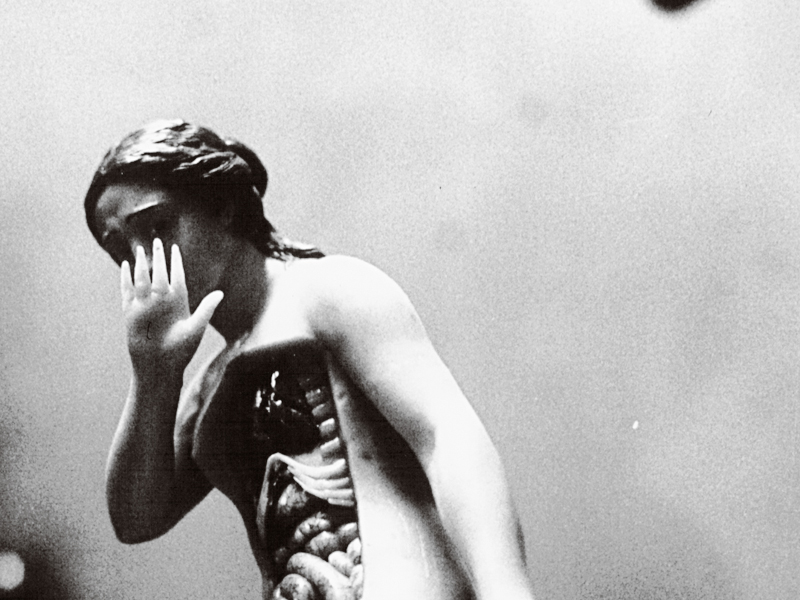
Short Cuts: Connections to the Body
The exhibition Short Cuts: Connections to the Body negotiates a fashionable subject: the body. Fashion is deeply connected to the body. The body has become fashionable once again—not for the first time—as a discourse of science, technology, art, and exhibition. Through display, the body enters into fashion and returns to the exhibition space. Thus, the modern body continuously begins, turns, and repeats itself, designed and re-designed around its sites of presentation. Whether in the anatomical theatre in Leiden or the heart clinic in Fairfax, in the wax museums of the eighteenth century or the Hygiene Museum in Dresden, in the lecture halls of the Salpêtrière, in freak shows, cabinets of curiosities, white cubes, or blue boxes—this is where the body exists and is allowed to exist: the latest sensation.
At the beginning of the modern body stood the corpse. Frozen flesh, patient as paper, always ready to confess what had already been predicted about it. The sharp eye and the skilled hand—the expertise of the physician and the artist—together with their technical extensions and strange mutations, guided by “myriads of discourses,” have simultaneously dissected and shaped the body, destroyed and reinvented it, confusing death with life. The gaze of specialists assigned the body measures and proportions, enclosing unruly flesh within defined forms. In place of skin, a curtain has emerged—half veil, half screen—from which the perfectly tailored, flawless figure continually emerges.
Yet the ambition to bring light into this dark continent, to fully understand and master the body, has also produced its own shadow creatures. Within the panoramas of the body, an inverted double has been attached to it. Through images of the body without boundaries—a hybrid of interiors and surfaces—a “foreign body” has inscribed itself deeply into the flesh. A threatening scandal, an obscene, monstrous wound requiring sophisticated techniques in order to remain unseen at the very moment of revelation. Unveiling and concealing become one. Regardless of whether it is clothing or skin that falls away…
The body does not exist as such; what exists existentially are images—images that can be read as mirrors. Through its endless images and reflections, the body constructs itself and grows far beyond itself.
At the end of the opened corpse stands the modern subject, which confuses itself with the images it has produced. Even the first gaze that recognizes the body incorporates a reflected, censored and censoring image that claims: this is a body. Between gaze and body stretches a space in which images take place. Within this space, difference is structured as the differentiation between subject and object, life and death, male and female, white and Black, ideal and monster, culture and nature—a difference that always leads from one to the other, yet ultimately returns to the same. And that “same” is not a body, but rather something that claims to possess one.
Endlessly dividing and separating itself, displaced and extended through increasingly complex prostheses, the subject projects its body outward in order to reconnect with itself from this external position. Its extensions orbit around it like satellites: it is simultaneously ex-orbitant and ex-centric. Ultimately, the question is no longer about possessing a body, but about being connected to oneself.
The body has once again become a subject of discussion—and of fashion. This time in the form of the cyborg, which is both feared and celebrated as the figure that might finally make the body and its implications obsolete. But which body, suddenly? How can something become obsolete that has always already been considered precisely that?
A sheep carries the belief that identical genetic codes can produce identical beings—a belief that also leads even the most fragmented subject to insist, offended, on the right to be identical only with itself. Above all, the new millennium seduces and threatens with its promises—and promise-makers—of eternity.
The Exhibition
Short Cuts: Connections to the Body does not offer predictions or diagnoses of the body at the end of the millennium. It is not concerned with comprehensive overviews or “settlements with the past.” Instead, the exhibition aims to place brief cuts and overlays of possible (or impossible) readings into space—readings that intersect with the history and myths surrounding the body.
The exhibition presents works of contemporary art—including photography, objects/sculpture, installations, and video—as well as a series of light boxes and, finally, the viewers themselves.
The space is provided by an institution that is not an explicit art venue: the German Occupational Safety and Health Exhibition (DASA), whose central themes are humans, work, and technology, and whose mission combines education, prevention, and entertainment. Between the exhibition Short Cuts and its host venue DASA, there are therefore as many points of connection as there are exclusions.
The light boxes form a parallel subsystem within the exhibition. They contain image and text panels that examine representations and concepts of the human body across different contexts. Removed from their original settings, the images enter into unfamiliar relationships with themselves: they deconstruct and comment on one another while creating multiple new connections. Formally inspired by museum information media, they do not function as explanatory tools for the exhibited works. Instead, they take up their thematic fields, divert attention from them, and offer further points of connection.
Finally, the viewers themselves become a constitutive element of the exhibition, interpretation, and representation of images through their bodies and their acts of looking.
Through the interplay between four fields of reference—the artworks, the light boxes, the viewers, and the exhibition venue—the project attempts to intervene in the flow of narratives, texts, and textures surrounding the body: creating breaks and “false” connections through shortcuts and new points of attachment.
Literature
Iris Dressler, Vergiss nicht zu sterben, Kunstforum International, vol. 153, p. 100.