
-
Archive
-
Lecture
computer / spiel / film – Lectures and Films on Computer Games and the Moving Image
00:00 – 00:00
PHOENIX Halle
Free admission
Lectures + Screenings
Computer Games and the Moving Image
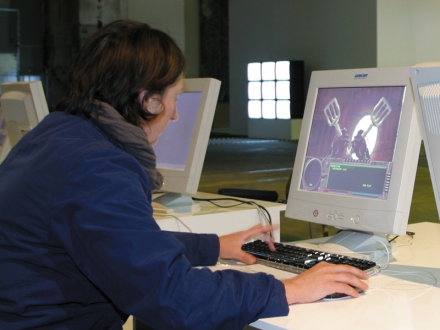
Computer games can be described as a hybrid media form that has incorporated elements from numerous other systems of representation – from architecture and painting to literature and film. At the same time, the aesthetics and logic of computer games are increasingly shaping a wide range of other media. The lecture and film programme computer/game/film focuses on some of these cross-media relationships, bringing together media and film scholars who examine the relationship between computer games and the moving image.
Film and games appear to “learn” from each other: on the one hand, cinematic forms of storytelling are adapted for computer games; on the other, digital effects have given film a spatiality and fluidity that originated in the 3D worlds of computer games. Analogies and differences between film and games – in terms of visual aesthetics and narrative structures – form a central focus of the programme.
Beyond film in the narrower sense, other forms of moving images are also discussed through the lens of computer games. These include simulation and visualisation technologies used in the military and in scientific research, as well as mass-media representations of warfare, which frequently draw on the model-like surface aesthetics of computer games and simplified game-like dichotomies such as friend/enemy or hero/antihero.
Further contributions investigate cinematic constructions of the hacker/gamer as a masculine role model and examine, from a sociological perspective, the consequences of the computer game’s “migration” from public spaces into private environments.
Alongside the cult film Tron (Steven Lisberger, 1982), the programme presents two short film programmes featuring video works from the past seven years that engage with the logic and aesthetics of computer games – whether by creating alternative cinematic narratives based on existing game scenarios, transferring virtual playing fields into real space, or exploring more broadly the entanglement of game aesthetics, simulation and live-action imagery.
The short film Do you have the shine? (Johan Thurfjell), for example, explicitly refers to a feature film source – in this case Stanley Kubrick’s The Shining. The video uses this reference point to simulate a form of interactivity that the original film deliberately does not offer.
Works such as She Puppet (Peggy Ahwesh) and Sheik Attack (Eddo Stern) quote elements from existing computer games such as Tomb Raider or SimCity and reassemble them into new cinematic narratives that disrupt the logic of their source material. Characters and game structures are placed within new, explicitly political contexts and re-evaluated according to these new frameworks.
Finally, in The Rumour of True Things, Paul Bush compiles imagery from flight simulators, footage produced in scientific experiments, surveillance videos and computer game sequences. Through their direct juxtaposition, the work reveals the entanglement of game aesthetics, simulation and real images.
Venue
Former Spare Parts Warehouse at Phoenix West
Hochofenstraße / corner of Rombergstraße
Dortmund-Hörde
Curator
Katrin Mundt
A project by
hartware medien kunst verein +
medien_kunst_netz dortmund
The accompanying programme is supported by
Cultural Office of the City of Dortmund
Fonds Soziokultur
Heinrich Böll Foundation NRW
International Short Film Festival Oberhausen